
Archuleta Projected vs Actual Release
A projected release date is a working estimate or eligibility date. An actual release date is the date the person really left a facility or custody system. In Archuleta County, a person in pretrial jail custody may have no set release date at all. Bond, a court order, a hold, identity processing, or a transfer decision can control when the jail may release the person.
A sentenced state prisoner is different. Once a person is sentenced from Archuleta County to the Colorado Department of Corrections, the county jail transfer is not the final release to the community. CDOC release timing is shaped by Colorado statutes, earned time, parole eligibility, mandatory parole, discipline, and parole-board action. The CDOC Offender Search is the public state-prison lookup point, but it is not a certified time-computation record.
Find Archuleta Inmate Release Date
Start with the system that has custody. A county-jail bond release is not computed the same way as a CDOC prison sentence. A transfer to state prison is not a community release. A federal sentence is not a CDOC case. If the online result is thin or missing, the fallback is a narrow records request that asks for the booking or release event by name, date of birth, booking date, and approximate release date.
- Check whether the person is held at the Archuleta County Detention Facility, CDOC, federal custody, or ICE custody.
- For county jail custody, check JailTracker while the record remains visible and review the court docket for bond or release orders.
- For a county release record, request the booking and release event from the sheriff records process.
- For a CDOC sentence, search by DOC number when possible, then by name and gender if needed.
- For a parole question, use the CDOC profile and parole-board schedule instead of the county probation office.
- For a pending custody change, use VINELink Release Check as an alert tool, then confirm with the record custodian.
For a released county-jail detainee, the release record and court docket often explain what happened: bond posted, sentence completed, charge dismissed, warrant cleared, probation ordered, or transfer made. For a released state prisoner, CDOC and parole records explain whether the person is discharged or still under state supervision.
CDOC Release Date Search
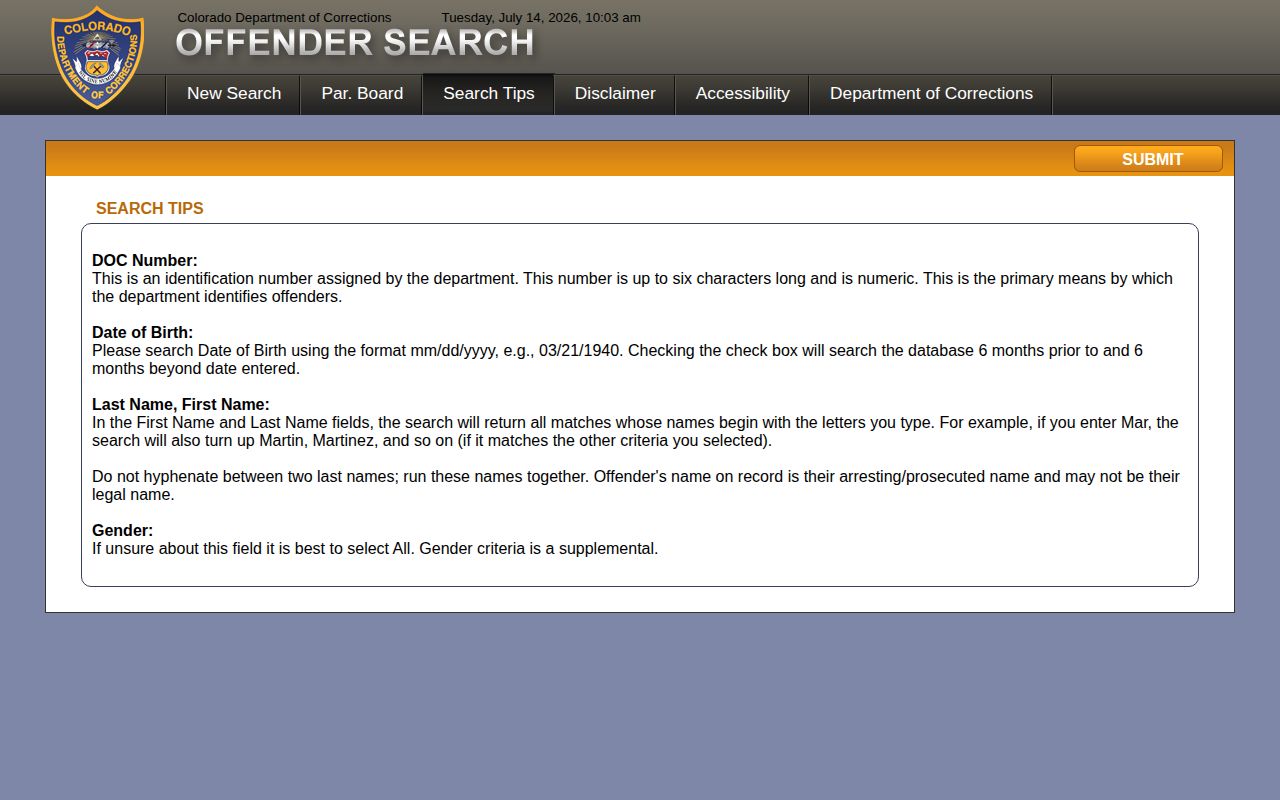
The Colorado Department of Corrections Offender Search applies to people sentenced to CDOC from Archuleta County. It should not be used as the main path for a person who only bonded out of county jail. CDOC's search form exposes DOCNO, last name, first name, and gender. CDOC says DOC number is the primary department identifier. Name searches match names that begin with the letters typed, and hyphenated last names should be run together.
Research could not verify exact current public profile labels for a projected or tentative date because direct automated result requests are CAPTCHA-protected. Do not assume a visible field label that has not been captured. Use verified statutory terms such as parole eligibility, earned time, mandatory parole, release, and discharge, then confirm disputed calculations with CDOC or the court record.
| Search field | Use | Research note |
|---|---|---|
| DOCNO | Best identifier for a CDOC inmate. | CDOC describes it as the primary department-assigned number. |
| Last name | Useful when the DOC number is not known. | Name matches begin with the typed letters. |
| First name | Narrows common last-name results. | Use with last name when possible. |
| Gender | Supplemental filter. | Helps sort similar names. |
The CDOC Search Tips page is the source for name and DOC number behavior.
Colorado Earned Time Rules
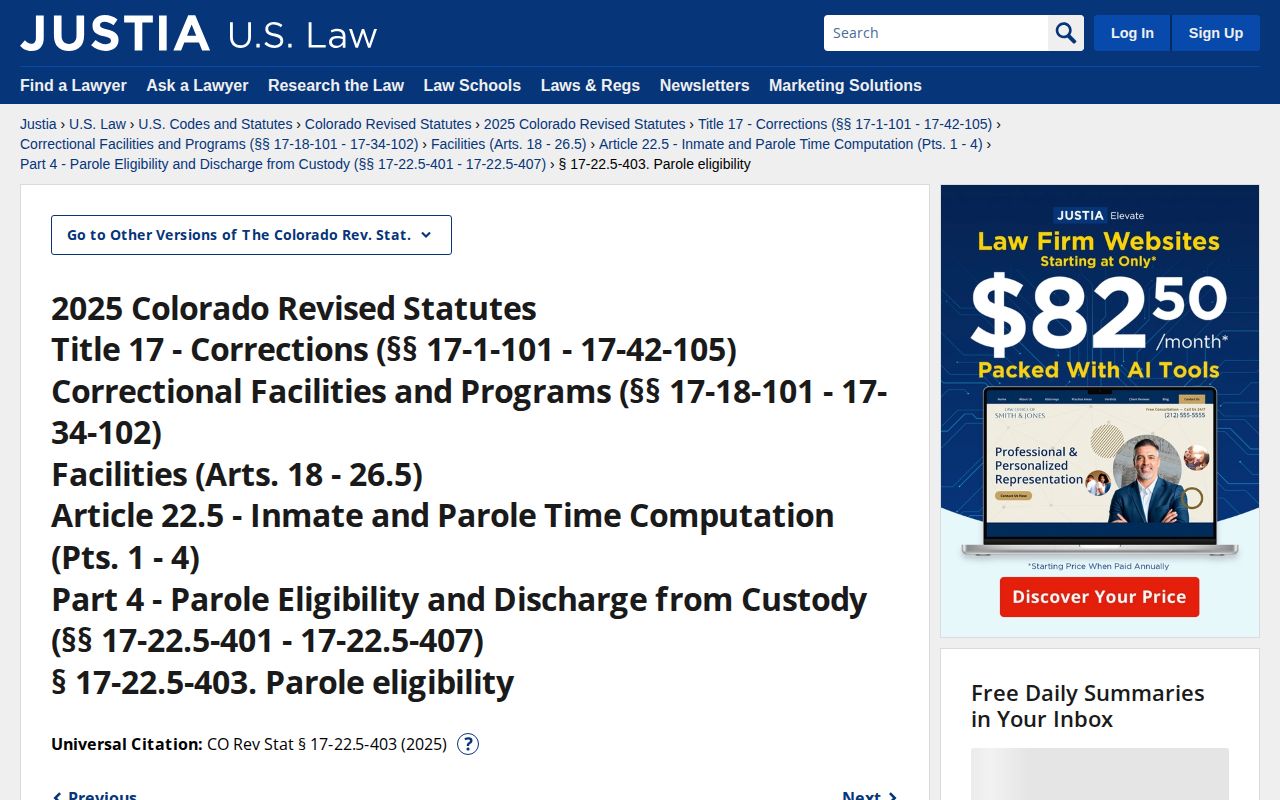
Colorado prison release timing is not a single arithmetic rule. C.R.S. section 17-22.5-403 governs parole eligibility for many felony and drug-felony sentences. For many listed categories, eligibility begins after service of fifty percent of the imposed sentence, less authorized earned time. The statute also allows misconduct to extend the eligibility date under rules set by the executive director.
C.R.S. section 17-22.5-405 governs earned time. It allows deductions, often up to ten days per month for demonstrated progress, and twelve days per month for some eligible lower-level felony and drug-felony cases. Except for listed exceptions, earned time may not reduce a sentence by more than thirty percent. Earned time can be granted, withheld, withdrawn, or restored.
Mandatory parole is a separate issue. C.R.S. sections 18-1.3-401 and 18-1.3-401.5 address mandatory parole after imprisonment for felony and drug-felony sentences. A person may leave prison yet remain under mandatory parole. Certain violent-offense categories can also have higher service requirements, including the post-Proposition 128 85-percent concept. Do not apply that rule to every CDOC sentence because offense, conviction date, and current law matter.
The Colorado parole eligibility statute was captured for release-date research.
Archuleta Bond Timing Difference
Archuleta's local bond-release timing and CDOC prison time computation operate under different rules. The sheriff's money-bond notice says bond fees, booking fees, and other debts do not need to be paid to secure release on money bond. The payor must pay the bond amount. The same notice says the sheriff must release a defendant within six hours after listed personal-recognizance or cash-bond conditions are met unless extraordinary circumstances exist.
Electronic monitoring can change that timing. The notice allows a hold of up to 24 hours when required electronic monitoring fitting is necessary. That is a county-jail processing rule tied to bond release. It does not predict a CDOC parole eligibility date, earned-time award, mandatory parole term, or parole-board decision.
This is the key Archuleta release-date distinction. A pretrial jail release may be a bond and processing question. A CDOC release date is a sentence and statute question. A transfer from the jail to CDOC shifts the date question from the sheriff and court to CDOC and parole records.
Archuleta Jail Sentence Dates
A county jail sentence has its own release-date path. The court order, often called the mittimus in sentencing contexts, tells the jail what sentence or commitment has been imposed. Jail credits, presentence confinement credit, sentence start date, other holds, and any later court order can affect the date. The sheriff's office can confirm the jail custody event, while the court record explains the sentence and any later change.
Do not apply CDOC earned-time rules to a short local jail sentence unless the person has been committed to CDOC. The Archuleta County Detention Facility holds pretrial detainees, people serving local sanctions, and people awaiting court or transfer. Once a person is sentenced to state prison, the county release record may show a transfer rather than a community release. The later prison release date then belongs to CDOC.
A narrow records request should ask for the booking date, release date, release reason, and transfer destination if there was one. A court-record check should look for the sentence, bond events, warrant status, disposition, probation order, and any credit or amended order. Together, those records explain why the projected date matched or changed.
Why Archuleta Release Dates Change
Projected release dates change because custody status changes. A court can modify an order. A new warrant can block release. A detainer can turn a local release into a transfer. CDOC can grant, withhold, withdraw, or restore earned time. The parole board can grant, deny, defer, rescind, suspend, or revoke parole within its authority.
| Change factor | How it affects the date | Where to verify |
|---|---|---|
| Bond not posted or conditions unmet | No county jail release occurs until the legal and processing conditions are met. | Jail record and court order. |
| Other warrant or hold | The person may transfer instead of leaving custody. | Sheriff, court, or holding agency. |
| Earned time change | CDOC eligibility or projected timing can move earlier or later. | CDOC records. |
| Misconduct | Parole eligibility can be extended under Colorado law and rules. | CDOC and parole records. |
| Parole decision | Grant, denial, deferral, rescission, or revocation changes the expected path. | CDOC profile and Parole Board calendar. |
| Court correction | Credits, sentence terms, or orders can be corrected. | Colorado Judicial Branch docket and case file. |
Parole After Archuleta Release
Release from physical custody does not always end supervision. A person sentenced from Archuleta County to CDOC may leave prison and begin parole or mandatory parole. A person sentenced locally may begin or continue probation through the court. Those are different records and different offices. The parole question is checked through CDOC and the Colorado State Board of Parole. The probation question is checked through the Archuleta County Probation office and court case.
The parole-board calendar inside CDOC Offender Search can explain hearing timing. It shows monthly calendars, warns that hearings are subject to change, and says DOC modifications will be available the following business day. For probation, use the local court and probation office, not the parole calendar. For more detail, use Parole / Probation.
Court records remain important even when the final custody status belongs elsewhere. The Archuleta County case can show the sentence, bond events, sentence completion, probation order, warrant history, or transfer order that caused the release-date question. CoCourts can provide a Register of Actions for case history, while the statewide docket search helps locate the local case.
Confirm Archuleta Release Date
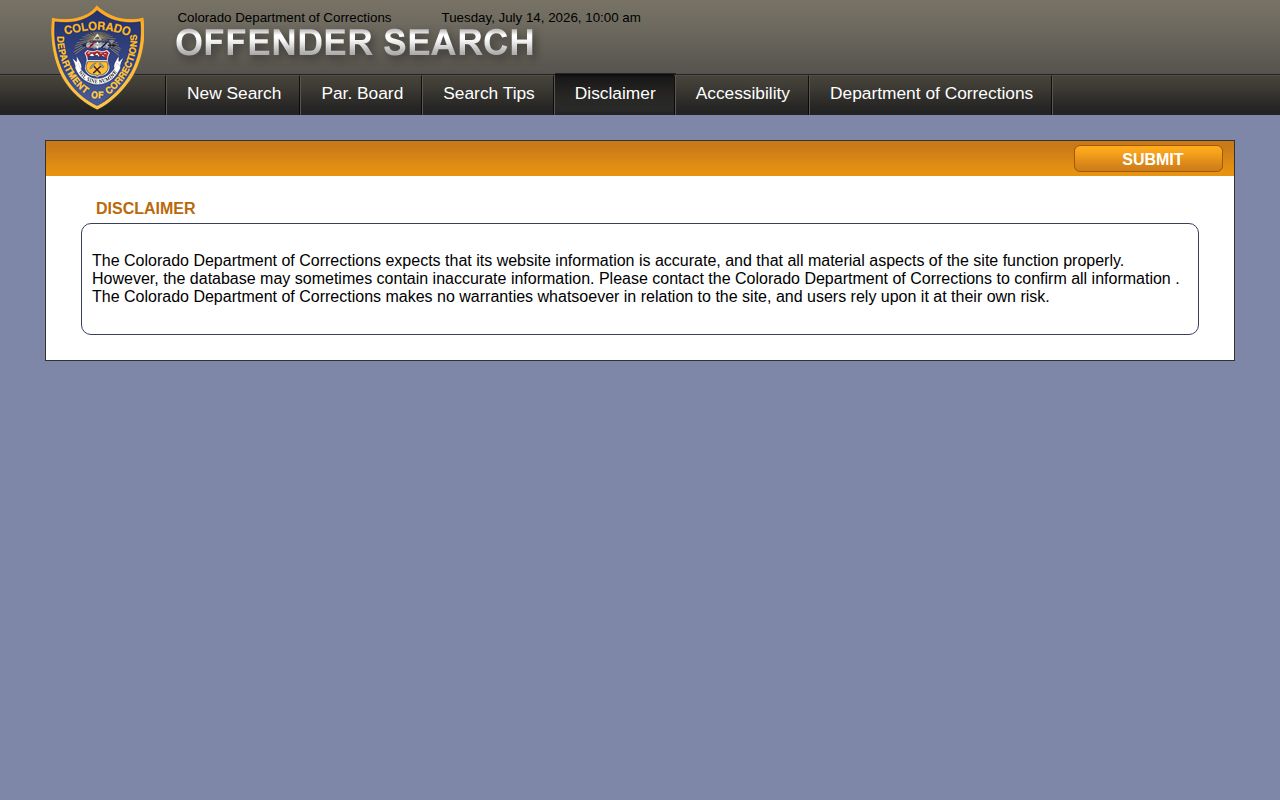
CDOC warns that its public database may contain inaccurate information and tells users to contact CDOC to confirm all information. That warning applies strongly to release-date questions. The public profile is a useful locator, but official release confirmation, time-computation disputes, and discharge questions belong with CDOC or the proper court and records custodian.
The CDOC Offender Search disclaimer is the source for that confirmation warning.
For a county jail release, contact the Archuleta County Sheriff's Office records process and review the court docket. For a state-prison release, use CDOC and parole records. For a federal or immigration matter, use BOP, ICE, USMS, or the federal court record. The system that holds the person controls the release-date answer.
Note: A posted release date can be a custody-system clue, not the final proof that supervision has ended.
Public Record Search
Sponsored Results